You are here: A Drive to Improve Kerb Appeal
Many people judge a property by what they see as they pass by. They note the condition of the façade of the building and the state of repair of the windows and doors, and as they get closer to the property, at the general tidiness of the garden.
Very often one aspect of the garden which gets overlooked in favour of the rose beds and hardy annuals is the driveway. Being of fairly robust construction, a driveway tends to deteriorate slowly and needs little day to day maintenance, provided it is not abused. There does come a time however, when the surface may need to be replaced as the surface wears or becomes cracked by tree roots, frost or just constant use.
At that stage, you need to decide what materials to use for the resurfacing Fashions change, new technologies have become available and there are now a wide range of products and finishes on the market, all with their own benefits and drawbacks. Whether your driveway is cracked, chipped, worn, or stained you need to choose which material best suits your needs and budget.
Gravel is a fairly low cost solution for driveway surfacing that is often used on larger rural properties. Gravel varies in quality with higher quality material costing more as it better consistency in size, shape, and colour. The gravel is laid in layers, with each layer being rolled and left to settle for a day or two between each layer. Gravel will need to be topped up occasionally, although edging helps to stop the gravel migrating. It should be laid with a permeable base to stop the ingress of weeds, but the final quality of the drive will depend on the quality of the hardcore base. Gravel also makes for a good additional security layer as it is almost impossible to either walk or drive over it without being heard.
Tarmac is another option at the lower end of the cost of the price range. The black colour blends in well with existing roads infrastructure and Tarmac is an exceptionally strong and durable material. Tarmac is not a naturally permeable material, it delivers a smooth, solid, sealed surface that repels water that often requires the installation of extra drainage channels, sloped edges or soakaways to prevent pooling A permeable tarmac using a porous asphalt is available and although more expensive, it allows rainwater to disperse through the surface and into the ground, allowing water to drain naturally into the water table.
Slabs and lock blocks are also very popular alternatives. These are laid on beds of sand which have been spread on a base of well compressed hardcore. Both slabs and block paving come in a variety of colours with the slabs also available in an assortment of sizes. Because of this, it is possible to design a drive with very individual patterns, although it must be remembered that the more intricate the pattern the more time consuming the laying of the drive can be. This will obviously have an impact on the cost. Well laid, good quality slabs or block paving looks good, is extremely durable and low maintenance.
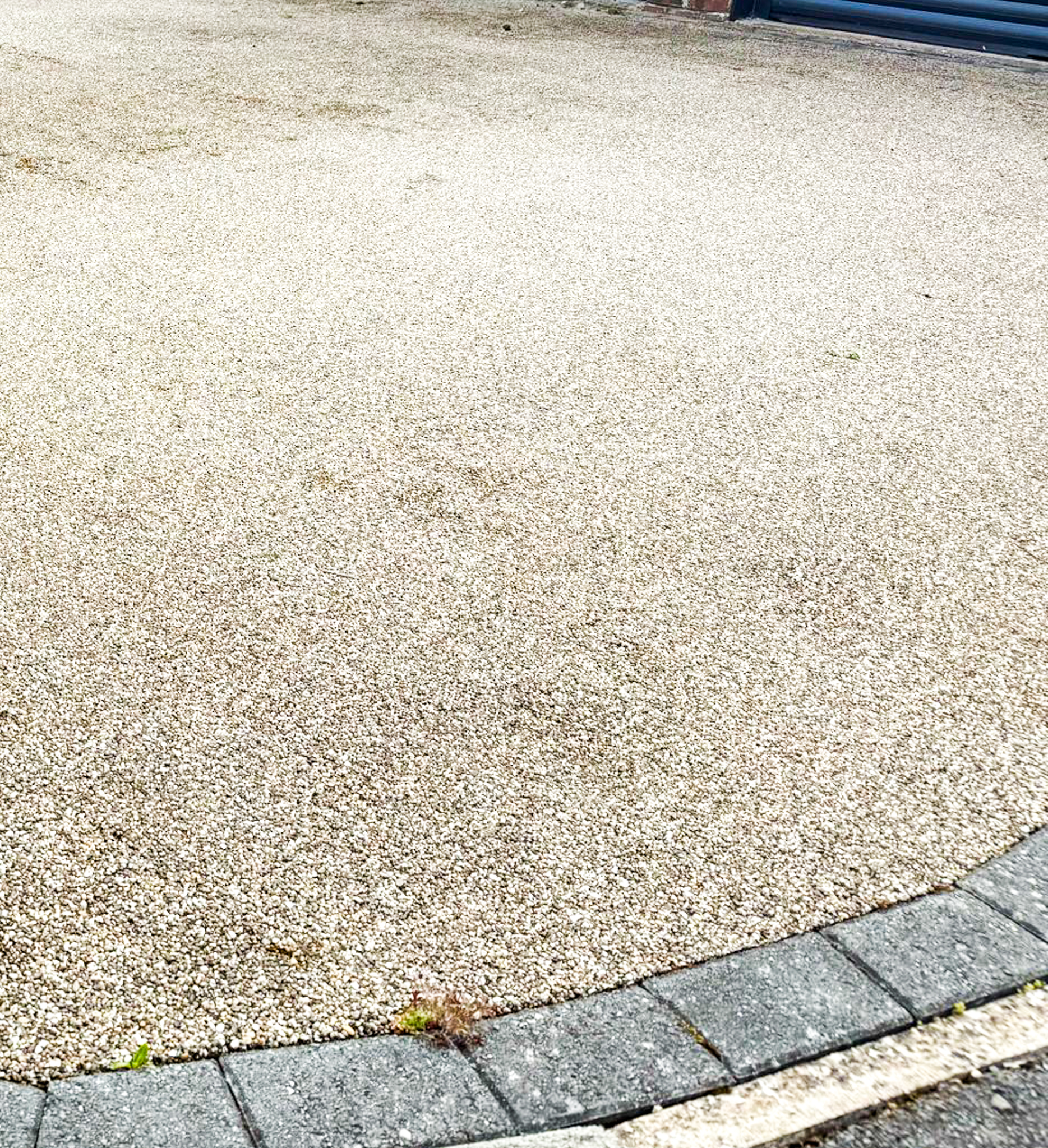
Resin Bound driveways are becoming very popular. They are permeable, decorative and have a natural finish that gives the appearance of gravel. Like slabs and blocks, the finished driveway depends on attention to detail when laying down a sub-base as this gives stability to the finished project.
The first step is to lay a sub-base of aggregate then a layer of concrete or permeable tarmac before mixing the gravel stones and resin ready for laying. Apply this mix with a large flat trowel and once laid, leave the surface to cure for twenty four hours before walking or forty eight hours before driving or parking on it. Resin Bound driveways offer a range of colour combinations and finishes to blend in with most sites.
If you are planning to install a driveway in the UK, surface water may become an issue as you should not allow surface water to run off into existing drains. You must manage surface water runoff to prevent it from overwhelming local drains. If you intend to lay traditional, impermeable tarmac on an area larger than five square meters will require planning permission. If you install a permeable surface such as permeable tarmac or gravel, you will generally be exempt from this requirement and can bypass the planning permission process by using your permitted development rights. There are two types of resin driveways, Resin-Bound which is permeable and can usually be done under Permitted Development. Resin-Bonded which is non permeable and will usually require Planning Permission.
Scientists tell us that global warming driven climate change will bring increased risk of heavier rainfall which makes adequate drainage from all garden surfaces, including driveways more important than ever with our drains being put under more pressure to cope with the volume of rainwater. This has prompted the government to introduce Sustainable Drainage Systems or SuDS in 2008 to combat the flash flooding caused by the prevalence of non-permeable concrete and tarmac. Any driveway which is not SuDS compliant will require Planning Permission.
As with most home improvement projects, driveways can be subject to budget restrictions. Driveways are priced up on a square meterage basis as the cost will be a combination of materials and labour cost times the square meterage. The other major consideration is the amount of time, effort and money your shiny new drive will take to maintain.
If you are considering buying or selling a home, you may find some of these services useful:

Mortgage Brokers
I need help getting a mortgage

Energy Performance Certificate
Energy Performance Certificates

Building Surveys
I want a local surveyor to do a Building Survey for me

Home Survey and valuation
I want a local surveyor to do a homebuyer survey and valuation for me

Structural Inspections
Find an expert to carry out a structural inspection
Structural Calculations
Find an expert to provide Structural Design Calculations

Invasive weeds report
If you are concerned that you may have Japanese Knotweed, or other nuisance plants.

Electrical Reports
Find an Electrician to produce an Electrical report (sometimes known as an Electrical Installation Condition Report - or EICR) for a property.